As most of you already know, I'm a big Star Trek nerd, and lately, with a decided lack of things to watch, I've gone back and started re watching the various incarnations of Trek, and rediscovering some of my favourite episodes. So I've decided to list them, for anyone who cares.
These episodes are in order of chronology in the Trek timeline.
The Original Series.As far as I'm concerned, nothing can really top classic Trek for me, and there are so many good episodes that I like, it was hard to pick just a few. I've picked the ones that I think show the best aspects of the ship and the crew's personalities and abilities.
The City On The Edge Of Forever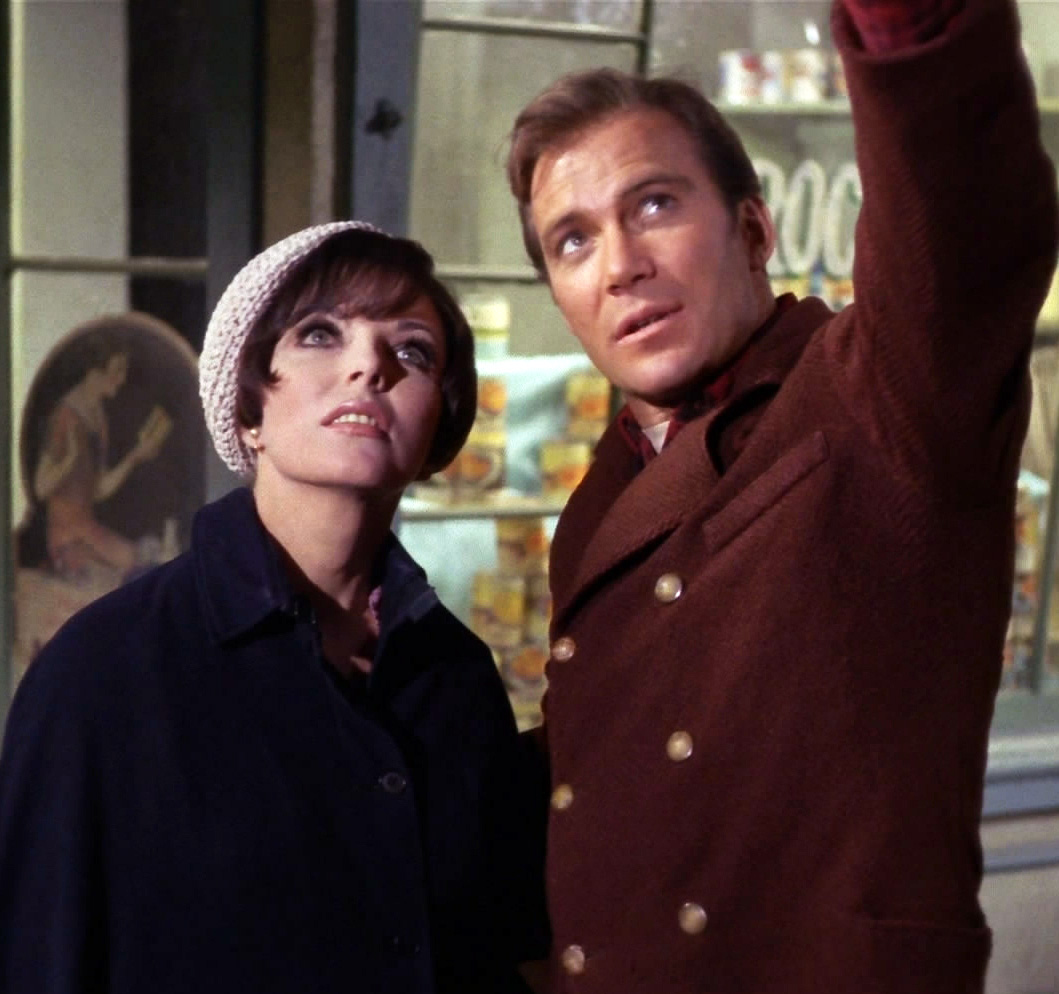
This is a great episode for character development and pathos. A medical accident in the sick bay causes Dr. 'Bones' McCoy to inject himself with a dangerous amount of drugs which make him to go bonkers. He manages to run amok through the ship and escape to the surface of a planet they orbit on which a strange device exists; emanating waves of temporal distortions that they were sent to investigate. Turns out this device is a talking time portal and McCoy ends up running through it to Earth's past, and inadvertently changes the history of Earth. They crew must now undo what he's done, with the help of the portal.
When Kirk and Spock go back to the 1920's, where they determine McCoy also went, they attempt to assimilate themselves into the period, and end up at a mission house under the direction of Edith Keeler (played by Joan Collins). After a few days, there is no sign of McCoy, but Keeler and Kirk strike up a burgeoning romantic relationship, which Spock warns him about: they must not make any alterations to the timeline. However, they soon discover that Edith Keeler is the key to the whole thing; whether she lives or dies is the pivotal point which changed history, but they do not know which.
Eventually Spock discovers that McCoy changed history by saving Edith Keeler's life. Keeler went on to organize a peace movement that delayed the United States' entry into World War II – and Germany was able to complete its heavy water and rocket experiments. With atomic bombs, and rockets to carry them, the Nazis conquered the world.
Soon enough, a deranged McCoy arrives in the past, and, after the effects of the drug wear off, he also ends up at the mission, unbeknownst to Kirk and Spock. At the end of the episode, Keeler casually mentions a man staying at the mission who says he's a doctor, and Kirk realizes that it must be McCoy. Leaving Keeler by the side of the road, he crosses the street to get Spock, and then McCoy happens to come out of the mission at that point. The three share a happy reunion, but mere seconds later, drawn to them by the display, Keeler crosses the street to join them, right in front of the path of an oncoming car. McCoy tries to run out there to save her, but Kirk holds him back, so that she can be killed and history will resume its normal shape.
The reason I like this episode is the blocking of this particular scene. The look on McCoy's face when he watches Keeler being run over, cut to the shot of Kirk's face over McCoy's shoulder, torn up inside, unable to watch but knowing exactly has done, to the shot of Spock watching the entire thing with an uncharacteristic empathy showing on his Vulcan face. Once the viewer realizes that Keeler has to die, the rest of the episode is a seat's edge viewpoint just waiting for the moment when it will happen, and just seconds after a cheerful scene of them finding McCoy. That's just good television in any era.
The Naked Time
The Enterprise investigates a planet doomed to natural destruction, and after beaming down to an outpost, discover the residents all dead under curious circumstances: some are found fully clothes in the shower, and all of them are frozen solid as the environmental controls were turned off.
Before returning to the ship, an Enterprise officer becomes infected by a few drops of contaminated water, and starts a chain reaction which infects most of the ship's crew over time. They all begin to display erratic behaviour; abandoning their posts and duties in order to embrace their most prevalent desires. Riley commanders the engine room and locks the controls, so now they are in the orbit of a planet about to explode but cannot get away.
Many people thought this was a hokey episode, but I like it because it shows off the amazing acting talents of Leonard Nimoy in one scene. Spock runs into Nurse Chapel, who has always harboured a major crush on him, once more professes her love for him, being under the influence of the water. She in turn infects him; he removes himself from Chapels arms, saying he can never love her, and leaves.
The next few moments are the best acting I've ever seen in the original series, and the scene was a single take by Nimoy, done at the last moment on the set as an alternate idea to the scene they were supposed to shoot. Spock begins to lose his Vulcan emotional control and struggles to get to his quarters so no one will see him. When he arrives, he struggles to regain control, reciting numbers and equations to himself, but ultimately failing and succumbing to the emotions he's repressed for so long. Simply brilliant.
The Next GenerationThe only thing that's even comparable to Original Trek is this one, except for the first season, which I really can't watch now. But TNG was the show that led the way for further canon development, and is still the best incarnation of the franchise. I was even able to mostly tolerate the presence of Counselor Troi in most of the run.
Sarek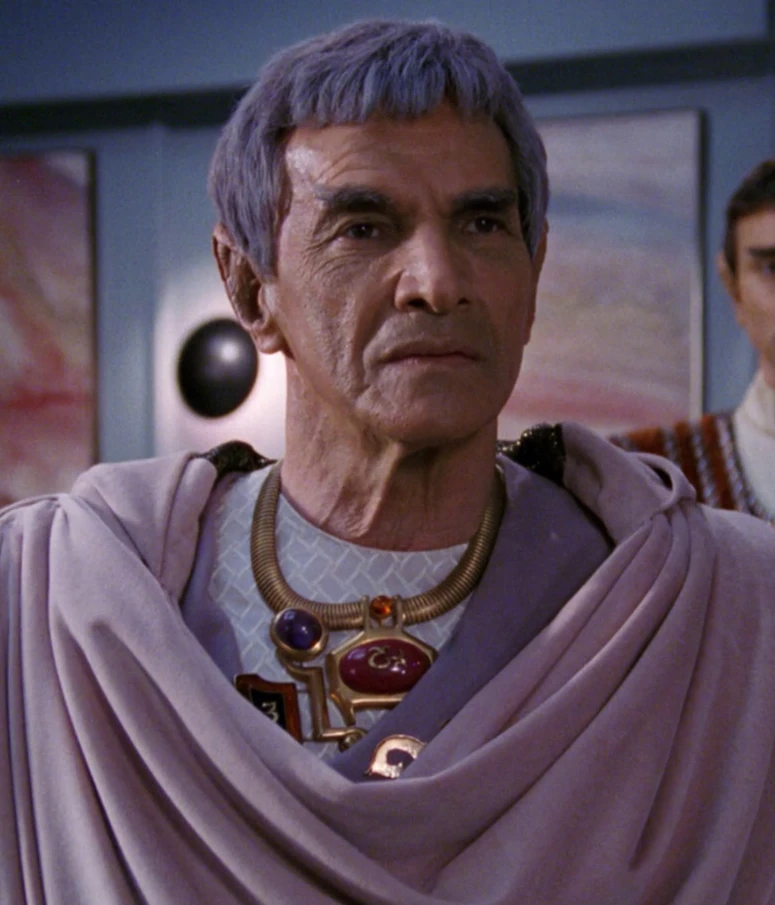
This episode features the amazing talents of two incredible actors, Patrick Stewart as Picard and the late Mark Lenard as Spock's father Sarek. In this episode, Sarek, still an ambassador but on his last mission as a peace negotiator before retiring, comes on board the Enterprise with his wife, Perrin, to hold the talks between two races. Soon, crew members on the ship begin to behave aggressively toward one another and no one can figure out why, not even the ones who were affected. After a concert where Data was a feature performer, Picard witnesses the supposedly unemotional Vulcan shedding a tear upon hearing the music, but then is ushered out by his wife and aides.
Picard soon becomes aware that Sarek is suffering from Bandii Syndrome, a rare disorder that causes Vulcans over 200 to lose emotional control, and he is unconsciously broadcasting his intense emotions to the humanoids around him. In this condition, he will not be able to continue the peace talks.
Confronting Sarek with this results in the first of two great acting moments, when Sarek becomes aggressive and angry at the suggestion that he cannot control his emotions, thus proving Picard's point.
The second moment comes later in the episode when Picard volunteers to mind meld with the Vulcan, in order to stabilize Sarek's emotions by giving him some of his own control. Sarek warns that in turn, Picard will feel the full brunt of his Bandii-affected mind, and it would be too much for a human to handle, but Picard does it anyway, and the resulting scene is amazing. Stewart as Picard (in a single shot) wrestles with Sarek's personal thoughts of sorrow, rage, fear and chaos in a mind-blowing feat of acting. Well worth watching again and again.
Remember Me
This episode isn't one that I think many people would say stood out, but it did for me for some reason. It was a very neat concept and executed quite brilliantly in the screenplay. Dr. Crusher is visited by her old mentor aboard the ship, a very elderly man, who is lamenting the fact that he is becoming increasingly lonely due to the fact that most of his friends and his wife have passed on. After this, she goes to visit her son, the prodigy Wesley, who is working on a warp experiment in engineering.
The next day, Crusher cannot find her friend aboard the ship -- moreover, she cannot find any evidence that he was ever there at all, and no one remembers him beaming up or being aboard. While trying unravel the mystery of this situation, she discovers some of her medical staff are also missing, and reports this to the bridge crew. No one seems to think this is odd. The situation continues and Crusher soon discovers that people on the ship are disappearing at an increasing level when Data casually informs her that the entire ship's compliment is 230, and not over a thousand as it is supposed to be.
Add to this the appearance of a strange explosion of light that appears to her alone, trying to draw her in but failing, and Crusher is faced with a serious mystery that she must unravel. Eventually almost the entire ship's crew disappears, including her son, and Crusher can only find Picard aboard -- the only other person aboard a ship that was built for a crew of hundreds. Picard, when confronted with this paradoxical information, simply says, "We've never needed a crew before."
Then Picard too vanishes leaving her alone, with only the computer to work with. It's at this point that we see that this bizarre situation is the result of Wesley's experiment with the warp drive; it has trapping her in a bubble of warp energy, the nature of which is controlled by her own thoughts -- she was thinking about losing people after her conversation with her mentor when Wesley botched the experiment, and now they have to find a way to get her out before the bubble collapses with her inside it.
The best parts of the episode are when Crusher is alone on the ship trying to figure out what's going on, and arguing with the 'computer'. She discovers that it's not only people that are disappearing, it's the planets and the entire universe (but really it's the warp bubble, not the universe). The look on her face when the computer tells her that the universe is "a spheroid region, 705 meters in diameter," is just priceless. Eventually she realizes that the light is related to Wesley's experiment and is a way out for her, and all is well again.
Parallels
Some of my favourite episodes are the ones where people are thrust into situations they have never been in before and also which they are ill equipped to handle. In this episode, on his Birthday, Worf returns from a fighting tournament dreading that someone will host a surprise party for him. Of course they do, and Worf is immediately uncomfortable. This sets the scene for the rest of the show, as Worf begins to notice slight changes in his surroundings. First he was told that Picard was unable to attend his party, then he was there eating cake.
As he goes about his day there is a lot of character development for Worf, as he has begun to feel romantic feelings toward Troi in this season, and there is much talk of his son, Alexander, and who would care for him is something were to happen to Worf, etc. This is all to set the stage for the events that follow, as Worf begins to experience dizzy spells, and every time he comes out of it, something is different. It begins to happen more and more, but when the differences become farther and farther removed from what Worf knows to be reality, he becomes rightfully concerned. He goes to visit the doctor for a checkup, who tells him that he must be suffering the effects of his concussion. Problem is, he hasn't had one. She insists he has, because of the injury sustained in the tournament, and a check of his quarters reveals a ninth place trophy, instead of the championship trophy he knows he's won.
The changes get worse, and the realities become more different. Worf begins to realize he's somehow shifting into alternate realities, but doesn't know how or why, and no one believes him. At one point, he finds himself in a universe where he is married to Troi, and he doesn't have a song called Alexander. A different shift plants him on the bridge and he has no idea how to run the security panel to fire the phasers on an attacking Cardassian ship because the panel is all different. His hesitation causes the ship to be fired upon and Geordi dies in the process.
As a result of this, Data runs a check and finds that Worf's RNA resonates a different quantum frequency and doesn't belong in their universe - he is from a different quantum reality. They surmise that he must have passed through an anomaly on his way back to the ship in his own universe that caused this to happen. Furthermore, they attribute the shifts in reality to Geordi's visor, because all the shifts took place when he was around Worf.
So now we come to the best part of the episode. In an attempt to locate the proper universe and return Worf to it, the Enterprise returns to the anomaly and does something wrong and opens up the barriers between universes and Enterprises from all quantum realities start appearing out of thin air. One of the best lines from this episode is, "Captain, we're receiving 285,000 hails." Then, when they discover which of the ships is the one from Worf's reality, they agree to send him back through the anomaly in their shuttle to hopefully return things to normal and stop the incursions from other universes before the universe collapses. Another great moment is when one of the ships from a universe where the Borg have taken over everything contacts them and a disheveled and insane Commander Riker refuses to go back and tries to fire on Worf's craft.
There are so many great moments in this episode, that I have to stop listing them, or they will go on forever...
Frame Of Mind
This is a great Riker episode wherein he is rehearsing for a play that Crusher wrote, called 'Frame of Mind' - the story of an insane man who struggles to separate his delusions from reality. Though throughout the episode, Riker begins to experience similar delusions to the context of the play, something he initially attributes to being too close to the character he is portraying. But the delusions get worse over time, until he finds himself actually in an insane asylum, and told that he is only imagining being the first officer of a starship, it is part of his delusional state. In reality, he has killed someone and been found to be insane.
Riker passes back and forth from the insane inmate to being on the Enterprise, and back again, but he is constantly berated and scolded by his doctor in the asylum that he has to want to remain in this reality if he wants to get better. As a result, Riker works hard to resist the 'delusions' of the Enterprise and its crew when they appear, and in one situation, they appear and try to rescue him from the asylum, and he resists, calling for security, but isn't able to escape their grasp.
The last 15 minutes of the episode are the best, as Riker initially crumbles under the strain of living in both realities, but then starts to observe clues that tell him whether things are real or not. Eventually he gambles his own life to sort out the real from the delusional by pointing a weapon at himself and stating that if this reality is delusional then nothing will happen to him if he shoots himself. In this way, Riker 'shatters' the delusions one by one (they actually use a shattering effect, very cool for the time when this was aired), until he ultimately finds himself a prisoner in a medical lab, by a race of aliens that are trying to extract vital information from him, and from whose imprisonment he eventually escapes.
I just like John Frakes' acting in this episode, and once again, it's an episode containing alternate realities and insurmountable odds, so it's a no-brainer that I'd like it.
Deep Space NineWhile I did watch this show's entire run, I simply didn't like it enough to say I would watch it all again. Sisko was a great character, and Avery Brooks a great actor and that was mainly what kept me interested. But mostly, the show was far to politically based for me, what with the Cardassians, the Bajorans and the Founders and all that stuff, was a little to influence by Babylon 5, IMO. However, there were a few memorable episodes. Here are two.
Far Beyond The Stars
Like many of these other favourites, this is an alternate reality scenario, whereby Sisko begins to see visions and experience himself somewhere else. After a period of self-doubt about his command and his place as the supposed prophetic Emmisary, Sisko, sees visions of strange people walking around the station. They get worse, and he suddenly finds himself on Earth circa 1950 as Benny Russell, a science fiction writer working for a theme magazine. Furthermore, all the major players of DS9 are in this vision as well, playing Benny's fellow writers, his fiance, his detractors and so forth.
I've always been drawn to movies and television that deal with the history of race prejudice and discrimination, such as 'Malcolm X' and 'Roots' (which both Avery Brooks and LeVar Burton acted in), and this is the crux of this episode, and a very interesting take on the idea. The writer Benny, being a black man in the 50's cannot get his story of a futuristic space station published because the commander is coloured, and the publishers continuously veto the story saying the public will never accept the story of a negro in a position of authority. The story, of course, is that of DS9, the idea of the vision being that Benny's struggle with the issue of getting the story published will somehow help Sisko to put things in perspective about being on DS9 and the responsibility he holds.
While many might say that this is one of the preachier episodes, I agree that it may be, but the end makes it well worth the hammered-home message. Everyone at the magazine agrees that Benny's story is great and needs to be published, but the editor insists that it will not be unless Benny changes the character of the black commander. Someone then suggests that the entire story could be simply a dream, and this is the loophole they need to push it through. However, weeks later when the editor returns, he informs them all that the entire issue has been pulped as it 'did not live up the the usual high standards.' Benny knows that it was his story that caused this decision from the publisher and becomes hysterical with rage over it, eventually collapsing in an emotional heap. It is simply the best acting moment in the entire series.
There are many episodes of Trek that cover the issue of race discrimination, but all are couched in metaphor and allegory, using races and circumstances that only parallel real life... except this one."Far Beyond The Stars" hits home, accurately and powerfully, even so far as to use the 'N' word. It is definitely worth more than one viewing.
Trials And Tribble-ations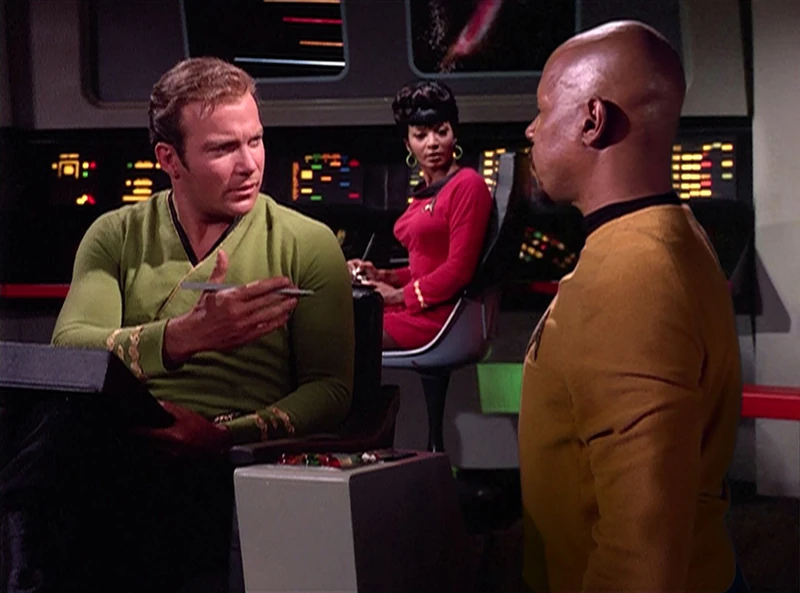
Ever since Frank Sinatra appeared in the vacuum commercial, dead stars are not safe, and yet this is the same technology that allowed the DS9 crew to travel back in time to Captain Kirk's ship, seamlessly and during one of the most loved episodes in the original series, "The Trouble With Tribbles."
Like the TOS episode, this one is very light hearted with many humourous moments, but the main draw for me was in seeing how the plot line, as well as the characters, interplay with that of the original episode. The creators, writers and effects people did an excellent job in doing this, reviving not only the episode footage, but the original sets, uniforms, and even actors to make this happen.
The basic premise of the episode was that Arne Darvin, the undercover Klingon agent conspiring in the original episode has done so again, and travels back in time (unwittingly taking the entire Defiant with him) to help his past self not be discovered as a spy and kill Captain Kirk. The entire story is framed as a flash back, as Sisko recounts the events to agents of Temporal Investigations -- they are there to determine whether harm was done and whether charges need to be brought against Sisko for temporal violations.
It's just a fun episode, and they pulled it off really well.
VoyagerI used to constantly argue with my mom about Voyager, because it's my least favourite show. Honestly, I dislike Captain Janeway very much. She assumed it was because I have something against women. That's not so. I really like Dr. Crusher's character, and also Ensign Ro and many others. I didn't like Janeway because I basically disagreed with every decision she ever made on the ship, right from when she made the decision which stranded her entire ship in the Delta Qaudrant. As a result of not liking her, I missed many of this show's eps during its run, but one episode does stand out.
Tuvix
This is an exploration of ethics, as a transporter accident causes the Vulcan Tuvok and the Talaxian Neelix, to become a single person, who becomes known as Tuvix. Not being able to reverse the effects of the meld right away, the crew and Captain Janeway have to come to terms that the two people they once knew are gone, and this hybrid is all they have left.
Eventually, Tuvix becomes a valued member of the team, and people start to regard him not as an accident, but as a unique individual, possessing all the best qualities of Tuvok, and Neelix... that is until one month later, the Doctor, under his original orders from the captain, discovers a way to reverse the meld.
When presented with this idea, Tuvix states that he doesn't want to go through with the procedure - he doesn't want to die. Although he refers to Tuvok and Neelix as his 'parents', and does care about them, he is afraid. It is Kes, lover to Neelix and protege to Tuvok, that ultimately convinces Janeway to somehow force Tuvix to undergo the procedure.
Janeway states her intention to Tuvix who pleads with the crew not to murder him, but finally realizes he has no choice, and allows himself to be led to Sick Bay. There, the doctor, citing the hypocratic oath to 'do no harm', refuses to perform the separation, so Janeway does it.
It is one of the only decisions of Janeway's that I did agree with, although the ethics surrounding it are murky, and it was clear that Janeway herself had doubts even after committing herself to the decision to sacrifice one life, such as it was, to save two.
EnterpriseRegarded by fans as the most controversial and argued over series in the franchise, I side mostly with those who like the show. While I did agree that they took many liberties, I think that what they did do with this was good-intentioned, and the grandiose ideas of prequel lore were mostly well-executed, especially in the final fourth season. But because the presentation of the show's plot was spread out over many episodes, almost in mini-series fashion, it was hard to pick episodes that stood out... except this one.
Acquisition
Trek lore states that the Ferengi race of monetarily minded aliens did not come into the foray until Picard's time. However, 150 years earlier, Picard's predecessor John Archer's ship was taken over by a contingent of them, in the form of looters.
A trap laid by the Ferengi causes the entire crew to be knocked out by gas, except for Trip, who was in a decontamination unit at the time. He leaves from there, and then discovers the crew out cold, and realizes something is up. In time, he manages to hit sick bay and grabs something that wakes up T'Pol and Captain Archer only. The rest of the episode is just gold, because the writing really goes out of the way not to outwardly state that this is the Ferengi race -- they are supposed to be unknown in this time period. But the viewer is aware of who they are and how they work, and we can also anticipate the Ferengi reactions to things which is a nice interaction. In any case, with enough clues, the three officers gather sufficient information about the inner workings of the Ferengi mind, which is powered by greed, suspicion and trechery. Trip and Archer basically mimic the Ferengi, act exactly like them, to stage a power play between them both, tricking the Ferengi into letting their guard down so the humans can gain control and put their ship back together. It's really a very well written and clever episode.
So there's my list. There are of course many more episodes that I like, but I won't bore anyone anymore with the stories of how I spent all day struggling to decide which ones were my favourite when I should have been working.


)


